Internationals

Companies

Language Schools

Clubs



The Blueprint · Article 3 of 4
⏱ 7 min read🧭 The BlueprintLearning Path

So, you’ve survived your first few trial practices. You’ve successfully navigated the locker room, you’ve learned how to sweep the court, and you might even have shared a post-workout soda with your new teammates. You are officially ready to join. Then, you receive an email with a payment link for something called the “Kontingent”.
Suddenly, the warm, informal vibe of the sports club is replaced by an invoice and a strict deadline.
For many internationals, this is where the cultural confusion rears its head again. How does the payment structure actually work? Why do you have to pay for an entire half-year upfront? And why is the club suddenly acting like a strict bank if you are two days late on your payment?
To fully integrate into a Danish forening, you need to understand the philosophy behind the kontingent (the membership fee). It is not just a transaction; it is your official stake as a shareholder in the community.
Let’s address the most common misunderstanding right away: The kontingent is not a pay-per-use service.
If you join a commercial yoga studio, you pay for the classes you attend. If you go on a three-week holiday to Thailand, you might pause your subscription because you aren’t using the service.
If you try to bring this logic to a Danish sports club, you will be met with profound confusion. If you email the club and ask, “Hi, I will be traveling for three weeks in October, can I get a 25% discount on my autumn Kontingent?”, the answer will be a polite, but very firm, no.
Why? Because the kontingent is your contribution to the club’s very existence. The club’s expenses—tournament fees, league registrations, new balls, and facility maintenance—do not disappear just because you are on a beach in Phuket. By paying your kontingent, you are funding the collective framework that makes it possible for the team to exist at all. You are paying to keep the community alive, whether you show up to practice or not.
Depending on the sport, you might look at the kontingent and think, “Wow, this is incredibly cheap compared to back home!” Or, for sports with expensive equipment, you might think it’s quite an investment.
But behind the scenes of that price tag lies a unique Danish partnership. Sports clubs in Denmark are heavily subsidized by the local municipality (Kommune). The government believes that grassroots sports are essential for public health, social cohesion, and democracy. Therefore, the municipality often provides the physical facilities — the pitches, and the indoor gymnasiums — to the clubs for free, or at a radically reduced price.
Your kontingent only covers the remaining operational costs. It is a beautiful three-way partnership: The state provides the facilities, the volunteers provide the labor, and you (the members) provide the kontingent to buy the equipment.
There is one person in the club you should never upset: Kassereren (The Treasurer).
In commercial businesses, late payments are handled by automated systems. In a Danish forening, the treasurer is a volunteer. It is often a teammate or a parent who, after a long day at their real job, sits down at their kitchen table on a Sunday night to balance the club’s budget manually.
When you don’t pay your kontingent on time, an automated robot doesn’t chase you. A volunteer has to manually find your name, write you a reminder email, and stress over whether the club has enough money in the bank to buy the new match jerseys for the weekend.
In Denmark, paying your kontingent promptly is considered the ultimate sign of respect for the volunteers. If you receive a rykker (a payment reminder), do not ignore it. Pay it immediately, and ideally, add a quick “Sorry for the delay, thank you for your work!” to the treasurer.
Because the club is a democracy, the size of the kontingent isn’t decided by a greedy CEO looking to maximize profits. It is decided by you.
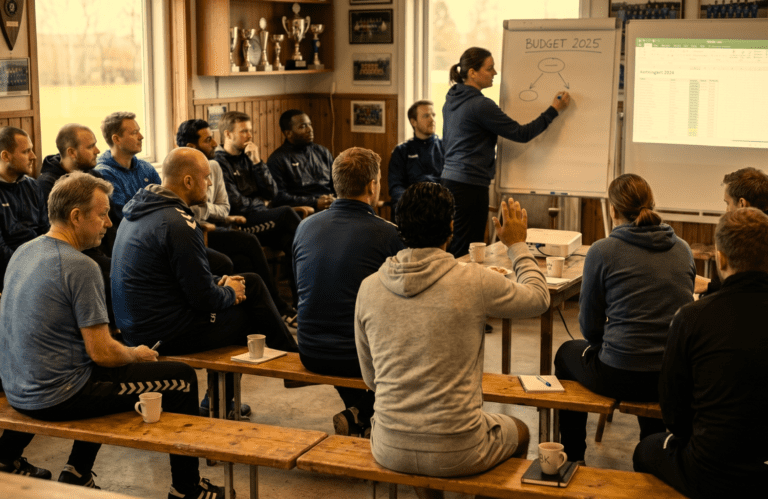
Once a year, the club holds its Generalforsamling (General Assembly). Here, the budget is presented transparently to all members. If the club needs new goals or wants to host a large summer party, the members might collectively vote to raise the kontingent by 50 DKK. If the club has a surplus, they might vote to lower it or spend the money on an end-of-season trip.
Paying your kontingent is the final step in your transformation. The moment that payment clears, you are no longer a guest. You are a fully-fledged, voting co-owner of a Danish institution.
In the fourth and final part of the Blueprint series, we will decode the famously flat Danish hierarchy, and how you should (and shouldn’t) speak to your coach.